Harbor Feelings
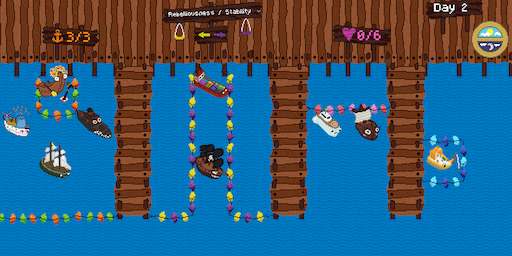
The idea for this game sprouted from the play on words of shipping (as in boats) and shipping (as in putting into a relationship). It started as part of a game jam run by the WPI branch of the International Game Developers Association, on a team with two of my friends, but quickly grew out of scope and into a summer project.
Design and Gameplay
Harbor Feelings is played on a day-night cycle: During the day, the player can set up the boats in different relationships and means of learning more information, and at night everything plays out, pairs are made and broken, and new knowledge is gained. Over the first few days, more boats are added and new mechanics are introduced to guide the player towards victory. The game ends once all of the boats have found what they were looking for, with the amount of days taken serving as a score.
Process
We came up with the various mechanics for the game one late night in front of a whiteboard, bouncing ideas off of each other and seeing what sounded good. We knew we wanted several mechanics to reveal different pieces of information about each boat, and designed the basic gameplay loop off of this principle. The toughest part was the writing, since none of us had much experience in game writing, and we were still trying to work within the scope of the game jam at this point. We started a spreadsheet correlating the dialogues between each boat and every possible partner, gradually filling them in as ideas struck. Having three people working on this at once sped up the process but did create some discrepencies in some of the characters' personalities (boatalities?) which are still somewhat noticible in the final product.
Playtesting was also an important part of the design of this game. It was really interesting watching people's reactions to the game as they tested out different combinations, and taking note of which parts of the game worked well and which ones were sources of friction during gameplay. In particular, the original version of the Decision Dock mechanic confused a lot of players and thus underwent a major redesign quite late in development. There were also a few dialogues that had to be rewritten since they proved to be too confusing. During development we were nervous about the game being too difficult, playtesting helped affirm that the design was difficult enough to be fun while not so much that it was frustrating.
Conclusion
This project was certainly a step out of my comfort zone, taking a dive into game writing and also quite a bit of pixel art, but I very much enjoyed it. Doing things like this with friends always makes them better. This project also helped me form a bit of a bridge between game programming and traditional program design, since it required quite a bit more technical backend than most of the previous games that I've worked on. I'm hoping to take what I learned from making this game and apply it to other projects.